USDA Organic Seal Review for Supplements
Written for science-informed consumers

A bottle can use the word “organic” in several ways. The USDA Organic seal is different: it is a regulated certification mark with defined production, handling, recordkeeping, and labeling requirements. This USDA organic seal review focuses on what that distinction means when you are evaluating botanical supplements, whole-food formulas, and concentrated plant extracts.
For informed consumers and practitioners, the seal is a meaningful starting point, not a substitute for reviewing the complete formula. It can speak to how agricultural ingredients were grown and processed under the organic standard. It does not, on its own, establish an ingredient’s clinical relevance, extraction quality, dose, identity, or suitability for an individual.
How the USDA Organic Seal Works
The seal is overseen through the USDA National Organic Program. To use it, a product must meet the applicable organic labeling category and be certified by an accredited certifying agent. Certification is not simply a supplier statement or a marketing preference. It requires documentation and verification across the supply chain, from agricultural production through processing and final labeling.
For crops, organic standards generally address practices such as prohibited synthetic pesticides and fertilizers, genetically engineered ingredients, sewage sludge, soil stewardship, and measures that preserve the integrity of organic material during handling. Processors must also manage ingredient sourcing, sanitation procedures, storage, and segregation in ways that protect the certified product from commingling with nonorganic materials.
The 95% threshold matters
The familiar USDA Organic seal generally appears on products in the “organic” category, meaning at least 95% of the ingredients, excluding water and salt, are certified organic. The remaining ingredients must meet specific requirements and may only be used when permitted under the organic regulations.
This is different from a product labeled “made with organic” ingredients. That category requires at least 70% organic ingredients, but it cannot display the USDA Organic seal. A supplement that says an individual herb is organic may also be using a certified organic raw material without having a finished product that qualifies for the seal. Those are meaningful distinctions when comparing formulas.
Certification follows a paper trail
Organic status depends on traceability. Certified operations maintain an organic system plan describing their practices, inputs, suppliers, handling steps, and controls. They undergo inspection and must be able to substantiate their claims. A credible label should identify the certifying agent, usually near the manufacturer or distributor information.
For botanical nutrition, this documentation matters because an ingredient may pass through farms, drying facilities, extract manufacturers, blending operations, and encapsulation facilities before it reaches the finished bottle. The seal signals that organic controls are intended to remain intact through that chain.
What a USDA Organic Seal Review Should Confirm
When reviewing an organic supplement, start with the front label, then move directly to the Supplement Facts panel and other ingredients statement. A USDA Organic seal is useful evidence, but the formula tells you what is actually being delivered.
First, confirm that the seal appears on the finished product rather than only in marketing copy for one ingredient. Next, look for the certifier statement. Then assess whether the botanical is identified clearly by its common name and, when appropriate, its plant part or standardized extract details.
Amla is a useful example. “Organic amla” tells you something about the agricultural source and certified handling. It does not tell you whether the formula uses whole fruit, an extract, or both. Those formats are not interchangeable. Whole-fruit amla retains the broader food matrix, while a concentrated extract changes the ingredient profile and can increase the amount of selected plant constituents delivered in a smaller serving.
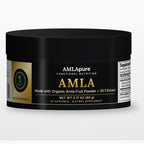
A whole-fruit + 30:1 extract formulation should state both components clearly. The 30:1 ratio describes the relationship between starting botanical material and finished extract, but it should not be treated as an automatic measure of superiority. Extraction method, botanical identity, marker compounds when relevant, serving size, and the intended role of the whole-food ingredient all affect whether a formula is well designed.
What the Seal Does Not Prove
The USDA Organic seal is rigorous within its scope. Its scope is not everything a discerning buyer needs to know.
It does not prove that a supplement is clinically effective for a particular outcome. Research on a botanical may be promising, mixed, population-specific, dose-dependent, or based on a different preparation than the one in a bottle. A responsible product review compares the actual form and serving amount with the available ingredient science rather than extending research beyond what it supports.
It also does not replace quality testing. Organic certification and laboratory verification address different questions. Identity testing helps confirm that the botanical is what the label says it is. Microbial, heavy metal, and other contaminant testing help assess product quality and safety specifications. Manufacturing controls help ensure that each batch is made consistently.
Likewise, USDA Organic certification is separate from dietary supplement cGMP requirements. cGMP-certified production concerns manufacturing systems such as specifications, sanitation, documentation, batch records, and quality control. An excellent botanical supplement program should treat organic certification and cGMP production as complementary standards, not competing badges.
Finally, organic does not mean appropriate for every person. Supplements can interact with medications, procedures, or health conditions. Enzyme products and concentrated botanicals deserve particular attention from people using prescription drugs or managing complex care. Practitioners should consider the complete client picture, not only the quality signals on the label.
A Practical Review Framework for Botanical Supplements
A disciplined label review is less about finding one perfect claim and more about checking whether the evidence aligns. Evaluate the finished-product certification, the transparency of the formula, the relevance of the serving size, and the manufacturer’s quality practices together.
For a plant-based supplement, ask whether the product identifies the botanical source precisely and whether it distinguishes whole-food ingredients from extracts. Look for meaningful formulation detail rather than vague proprietary language. If an extract is included, determine whether the label provides the extract ratio, standardization information when applicable, and the amount per serving.
Then consider the non-active ingredients. Capsule material, flow agents, flavors, and processing aids may affect the finished product’s organic status and may matter to consumers who prefer a minimal, plant-based formula. “USDA Organic” is valuable, but it does not eliminate the need to read the entire label.
For practitioners and retailers, documentation is part of the review. Product specifications, current certificates, manufacturing standards, and a clear approach to research and testing are more useful than broad wellness language. Brands that can explain why an ingredient form was selected are generally easier to evaluate than brands that rely on certification logos alone.
Why Formulation Still Comes First
The strongest organic supplement is not necessarily the one with the longest list of certifications. It is the one whose certification, ingredient selection, dosage form, manufacturing controls, and scientific rationale are coherent.
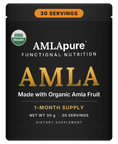
At AMLApure, that perspective informs a whole-food approach to botanical nutrition: pairing whole-fruit amla with a concentrated 30:1 amla extract where the formulation calls for both. The purpose is not to imply that one format replaces the other. It is to preserve the value of food-derived plant material while using a defined extract format with clear technical intent.
The same principle applies across supplement categories. A seal can help establish confidence in sourcing. Ingredient science helps explain the material. Research and testing help assess quality. The label should make it possible for a buyer or practitioner to see how those pieces connect.
Use the USDA Organic seal as a high-value filter, then let the complete formula earn the final decision. The most useful products make that review straightforward: certified sourcing, transparent ingredient forms, appropriate manufacturing standards, and claims proportionate to the evidence.


 Contact us